
کورونا وائرس کی عالمی وبا، 2019ء - 2020ء ایک عالمگیر وبا ہے جو کورونا وائرس مرض کے پھیلنے سے دنیا بھر میں پھوٹ پڑی ہے۔ اس وبا کا باعث سارس کووی 2 نامی وائرس ہے جس کی بنا پر انسانوں کا نظام تنفس شدید خرابی سے دوچار ہو جاتا ہے۔[4] دسمبر 2019ء میں چینی صوبہ ہوبئی کے شہر ووہان میں وبا کا ظہور ہوا اور اس برق رفتاری سے پھیلا کہ چند ہی مہینوں کے بعد 11 مارچ 2020ء کو عالمی ادارہ صحت (WHO) نے اسے عالمی وبا قرار دے دیا۔[5] 27 مارچ تک 190 ملکوں کے مختلف خطوں میں اس وبا کے 5 لاکھ انچاس ہزار سے زائد متاثرین کی اطلاع آچکی ہے جن میں سے 24 ہزار ایک سو افراد اس مرض سے جانبر نہ ہو سکے اور لقمہ اجل بن گئے، جبکہ 1 لاکھ اٹھائیس ہزار متاثرین کے صحت یاب ہونے کی اطلاع ہے۔[6][3]
Abu Hurairah reported: Muhammad said, "No Salat is more burdensome to the hypocrites than the Fajr (dawn) prayer and the `Isha' (night) prayer; and if they knew their merits, they would come to them even if they had to crawl to do so. [Sahih-Al-Bukhari and Sahih Muslim].
Ahmad and Muslim record that Aishah said, "I have never seen him (Muhammad) more in haste to do a good deed than he was to perform the two rakahs (Sunnah) before the morning (Fajr prayer)."[citation needed]
Abu Huraira reports that Muhammad said: "Do not leave the two rak'ahs of Fajr, even if you were being attacked by cavalry." This is confirmed by Ahmad, Abu Dawud, Al-Bahaiqi and at Tahawi.[citation needed]
Aishah reports that Muhammad said, "The two (sunnah) rakahs of Fajr are better than this world and all it contains." This is reported by Ahmad, Muslim, Tirmidhi and Nasa'i.[citation needed]
Abu Hurairah stated that Muhammad had said, "There are angels who take turns in visiting you by night and by day, and they all assemble at the dawn (Subuh) and the afternoon (`Asr) prayers. Those who have spent the night with you, ascend to the heaven and their Rabb (Lord), Who Knows better about them, Asks: 'In what condition did you leave My slaves?' They reply: 'We left them while they were performing Salat and we went to them while they were performing Salat.' " From Al-Bukhari and Muslim.
Aisha reported Allah's Messenger as saying: "The two rak'ahs at dawn are better than this world and what it contains." Sahih Muslim, 004:1573
Narrated Abu Huraira: Muhammad said, "If anyone of you can get one Rak'a of the 'Asr prayer before sunset, he should complete his prayer. If any of you can get one Rak'a of the Fajr prayer before sunrise, he should complete his prayer." Sahih al-Bukhari, 1:10:531
Narrated 'Umar: "The Prophet forbade praying after the Subuh prayer till the sun rises and after the 'Asr prayer till the sun sets." Sahih al-Bukhari, 1:10:555
Hadith mentioning Fajr
The following quotations regarding Fajr, the Islamic dawn prayer, are from books of Sunni hadith. These books relate accounts taken from the life of the Islamic prophet Muhammad, his family, and his companions. They were compiled by Islamic scholars after Muhammad's death. These quotations include information about those who related the accounts, as well as the accounts themselves.
Narrated Aisha: Muhammad never missed four Rakat before the Zuhr prayer and two Rakat before the Fajr prayer.
Format
The Fajr prayer consists of two rakat (prescribed movements). In a congregation, the leader of the prayer (imam) recites aloud. However, two sunnah rakaʿāt prior to the two Fard rakaʿāt are highly recommended.
The time period within which the Fajr daily prayer must be offered (with loud recitation of the quran) is from the beginning of dawn[4] to sunrise.[5]
Name variations Edit
Region/country Language Main
Arab World Arabic صلاة الفجر
(Ṣalāt al-Fajr)
Iran, Afghanistan, Tajikistan Persian, Dari, Tajik نماز بامداد، نماز صبح
(Namâz-e Sobh/Namâz-e Bâmdâd)
India, Pakistan Urdu بامداد نماز، فجر نماز
(Fajar namâz/Bâmdâd namâz)
Turkey Turkish Sabah namazı
Azerbaijan Azeri Sübh namazı
Albania, Kosovo Albanian Namazi i sabahut, Namaz i mëngjesit
Balkans Serbo-Croatian Sabah-namaz
Bengal Bengali ফজর (Fojor)
Nigeria, Niger Hausa Sallar Fajr (Subhi)
Poland Polish Fadżr
Greater Somalia Somali Salaada Fajar, Salaada Subax
Malay Archipelago Indonesian, Malay, Javanese, Sundanese Salat subuh, Solat subuh
Uzbekistan Uzbek Bômdôd namôzi
Iraqi Kurdistan Sorani نوێژی بەیانی
During the Muslim holy month of Ramadan the start of Fajr prayer time marks the beginning of the obligatory daily fasting (sawm).
Al-Fajr is also the name of eighty-ninth chapter (sura) of the Qur'an.
he Fajr prayer (lang-ar|صلاة الفجر}} ṣalāt al-faǧr, "dawn prayer" is the first[1] of the five daily prayers (salat) performed daily by practicing Muslims.[2]:470 Fajr means dawn in the Arabic language.
The five daily prayers collectively form one pillar of the Five Pillars of Islam, in Sunni Islam, and one of the ten Practices of the Religion (Furū al-Dīn) according to Shia Islam.
The Fajr prayer is mentioned by name in the Qur'an at sura 24 (An-Nur) ayah.[3] Inspired by the tafsir of the two hadiths that were transmitted on behalf of the Islamic prophet Muhammad, the worth of the Fajr daily prayer is explained as being God's most-favoured prayer since others are asleep.

CDC outlines the specific guidelines for the use of personal protective equipment (PPE) during the pandemic. The recommended gear includes:
respirator or facemask[134][135]
gown[citation needed]
medical gloves[136][137]
eye protection[138]
When available, respirators (instead of facemasks) are preferred.[139] N95 respirators are approved for industrial settings but the FDA has authorised the masks for use under an Emergency Use Authorization (EUA). They are designed to protect from airborne particles like dust but effectiveness against a specific biological agent is not guaranteed for off-label uses.[140] When masks are not available the CDC recommends using face shields, or as a last resort homemade masks.
Personal protective equipment
Precautions must be taken to minimise the risk of virus transmission, especially in healthcare settings when performing procedures that can generate aerosols, such as intubation or hand ventilation.[132] For healthcare professionals caring for people with COVID19, the CDC recommends placing the person in an Airborne Infection Isolation Room (AIIR) in addition to using standard precautions, contact precautions, and airborne precautions.[133]
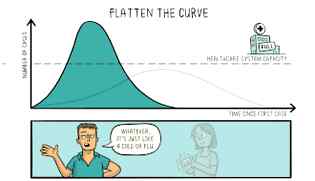
Currently, there is no vaccine or specific antiviral treatment for COVID-19. Management involves treatment of symptoms, supportive care, isolation, and experimental measures.[28]
The World Health Organization (WHO) declared the 2019–20 coronavirus outbreak a Public Health Emergency of International Concern (PHEIC)[29][30] on 30 January 2020, and a pandemic on 11 March 2020.[8] Local transmission of the disease has been recorded in many countries across all six WHO regions.[31]
9] The infection can also be diagnosed from a combination of symptoms, risk factors and a chest CT scan showing features of pneumonia.[20][21]
Recommended measures to prevent infection include frequent hand washing, social distancing (maintaining physical distance from others, especially from those with symptoms), covering coughs and sneezes with a tissue or inner elbow, and keeping unwashed hands away from the face.[22][23] The use of masks is recommended for those who suspect they have the virus and their caregivers.[24] Recommendations for mask use by the general public vary, with some authorities recommending against their use, some recommending their use, and others requiring their use.
The virus is mainly spread during close contact,[a] and by small droplets produced when people cough, sneeze, or talk.[14][16][15] Respiratory droplets may be produced during breathing but the virus is not generally airborne.[14][16] People may also contract COVID-19 by touching a contaminated surface and then their face.[14][15] It is most contagious when people are symptomatic, although spread may be possible before symptoms appear.[15] The virus can survive on surfaces up to 72 hours.[17] Time from exposure to onset of symptoms is generally between two and fourteen days, with an average of five days.[9][18] The standard method of diagnosis is by reverse transcription polymerase chain reaction (rRT-PCR) from a nasopharyngeal swab.
As of 3 April 2020, more than 1,010,000[5] cases of COVID-19 have been reported in more than two hundred countries and territories,[13] resulting in over 53,000 deaths.[5] More than 211,000 people have recovered.[
Coronavirus disease 2019 (COVID-19) is an infectious disease caused by severe acute respiratory syndrome coronavirus 2 (SARS-CoV-2).[6] The disease was first identified in December 2019 in Wuhan, the capital of China's Hubei province, and has since spread globally, resulting in the ongoing 2019–20 coronavirus pandemic.[7][8] Common symptoms include fever, cough, and shortness of breath.[9] Other symptoms may include muscle pain, sputum production, diarrhea, sore throat, loss of smell, and abdominal pain.[4][10][11] While the majority of cases result in mild symptoms, some progress to viral pneumonia and multi-organ failure.
Exegesis of the Qur'an can give four dimensions of salah. First, in order to glorify God's servants, God, together with the angels, perform "salah"[13][c]. Second, salah is done involuntarily by all beings in Creation, in the sense that they are always in contact with God by virtue of Him creating and sustaining them[14][d]. Third, Muslims voluntarily perform salah to reveal that it is the particular form of worship that belongs to the prophets[e]. Fourth, salah is described as the second pillar of Islam.[4]

submitted by
uploaded by
profile:
Sorry! Ap apne item ya profile ko report nahi kar saktey, na hi apne ap ko block kar saktey hain